FlemingClans.com

"Scotland's Fleming Clan: a Genealogical History" - coming in 2027!
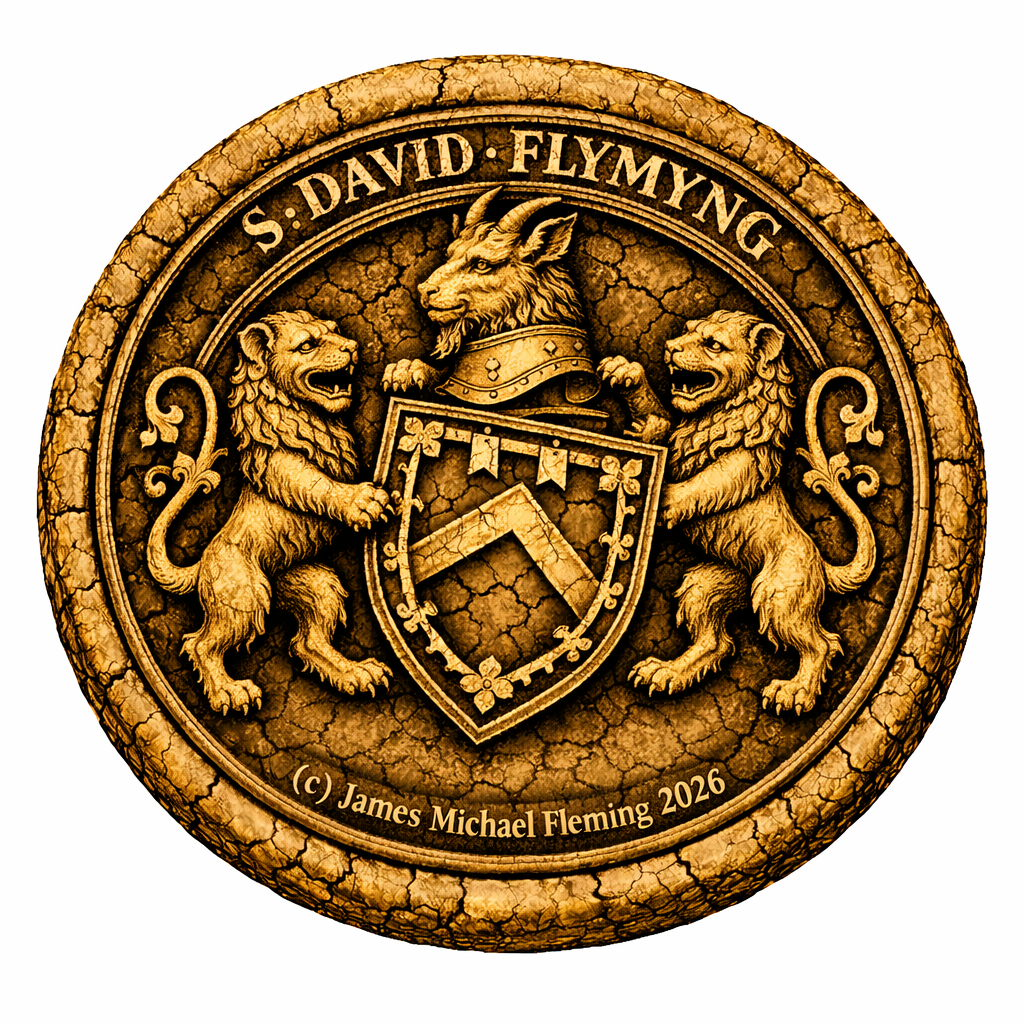 10th chief - Sir David Fleming of Biggar and Cumbernauld
(c1328 - 1406)
Basic information about this person: \click here\
Sir David Fleming, eldest son of Malcolm Fleming of Biggar, was a soldier, judge and diplomat who served three Scottish kings. He died defending the interests of the heir to the throne, and his murder helped set in motion one of the great crises of medieval Scotland.
Knight of King David II
David was born around 1328, probably at Biggar. He appears as a knight witnessing charters at Aberdeen in 1343, and around this time King David II granted him a fourth of the thanage of Meikle Morphie in Kincardine. By 1362 he was a knight bachelor of the royal household, and in 1363 the king granted him a pension of twenty merks plus one hundred shillings.
He was often trusted with business in England. In December 1363 he travelled to Westminster in a party of four led by Robert Erskine; in 1365 he was one of seventeen Scottish magnates given safe conduct to accompany the Bishop of St Andrews abroad; and in 1367 he escorted Walter of Biggar carrying six thousand marks towards the king’s ransom.
Marriages
David married first Margaret (also called Jean) Barclay, daughter of David Barclay, Lord of Brechin, by whom he had daughters Janet and Marion. His second wife was Isobel de Strachan, heiress of Monycabock (now Newmachar) in Aberdeenshire. Their sons were Malcolm, his heir, and David, who became the first Fleming of Boghall.
Parliament and the law
In 1369 Parliament appointed David to its Judicial Committee, and in 1370 to a committee on common justice. He was not always on the winning side: in 1370 he lost an appeal to Parliament in his long dispute with Robert de Colquhoun. On 27 March 1371 he attended the coronation assembly at Scone and swore homage and fealty to King Robert II.
Otterburn and Holyrood
David distinguished himself at the Battle of Otterburn on 5 August 1388, where the Scots defeated Henry “Hotspur” Percy although their commander, James Earl of Douglas, was killed.
Under King Robert III he drew a large income from Holyrood Abbey’s barony of Kerse near Falkirk, and he gave generously to the abbey in return. In 1398 he endowed a burial place for himself and his wife Isobel at the altar of St Nicholas, and in 1399 he paid for prayers, repairs and a glass window bearing his arms. In 1399 he was Deputy Chamberlain of Scotland and in 1403 an auditor of the national accounts.
Ambassador to England
In 1404 David was sent as ambassador to King Henry IV of England to negotiate the release of the Earls of Fife and Douglas, who had been captured at Homildon Hill. The truce he negotiated was confirmed by King Robert in September 1404. In June 1405 he received into Scotland Henry Percy, Earl of Northumberland, and Lord Bardolf, who were fleeing Henry IV after a failed rebellion. When he learned early in 1406 of a plot to hand them over to the English, he warned them and they escaped to Wales.
In August 1405 the king granted him the barony of Cavers in Roxburghshire with the office of sheriff. Cavers had been a Douglas property, and the grant made him powerful enemies.
Death at Long Hermiston Muir
In February 1406 King Robert III decided to send his only surviving son, the eleven-year-old Prince James, to safety in France. David Fleming and Henry Sinclair, Earl of Orkney, escorted the prince to the Bass Rock to await a ship. As David rode home he was attacked by James Douglas of Balvenie and his followers, and on 14 February 1406 he was killed at Long Hermiston Muir, west of Edinburgh. He was buried the next day at Holyrood Abbey, in the place he had prepared for himself.
Within weeks Prince James was captured at sea by the English, and on 4 April 1406 King Robert died, reportedly of grief. David’s loyalty earned him the nickname “the Trustworthy”, and his son Malcolm inherited Biggar, Lenzie and Cumbernauld.